Within the framework of the activities of the 14th International Conference of Ain Shams University (2026), held under the theme “Universities as Engines of National Development… Towards Innovation and Sustainable Economic Growth”, under the patronage of:
-
Prof. Abdel Aziz Konsowa, Minister of Higher Education and Scientific Research
-
Prof. Mohamed Diaa Zain El-Abedeen, President of Ain Shams University and Conference Chairman
-
Prof. Amani Kamel, Vice President for Graduate Studies and Research, Vice Chair and Executive President of the Conference
-
Prof. Ghada Farouk, Vice President for Community Service and Environmental Development and Vice Chair of the Conference
-
Prof. Rami Maher Sadeq Ghali, Vice President for Education and Student Affairs and Vice Chair of the Conference
The conference took place from April 19 to 20, 2026, at the Triumph Katameya Hotel in New Cairo.
The Faculty of Computers and Information, under the supervision of Prof. Rasha Ismail, Dean of the Faculty, participated in a specialized scientific session titled:
“Artificial Intelligence and Digital Transformation in Education, Scientific Research, and Innovation.”
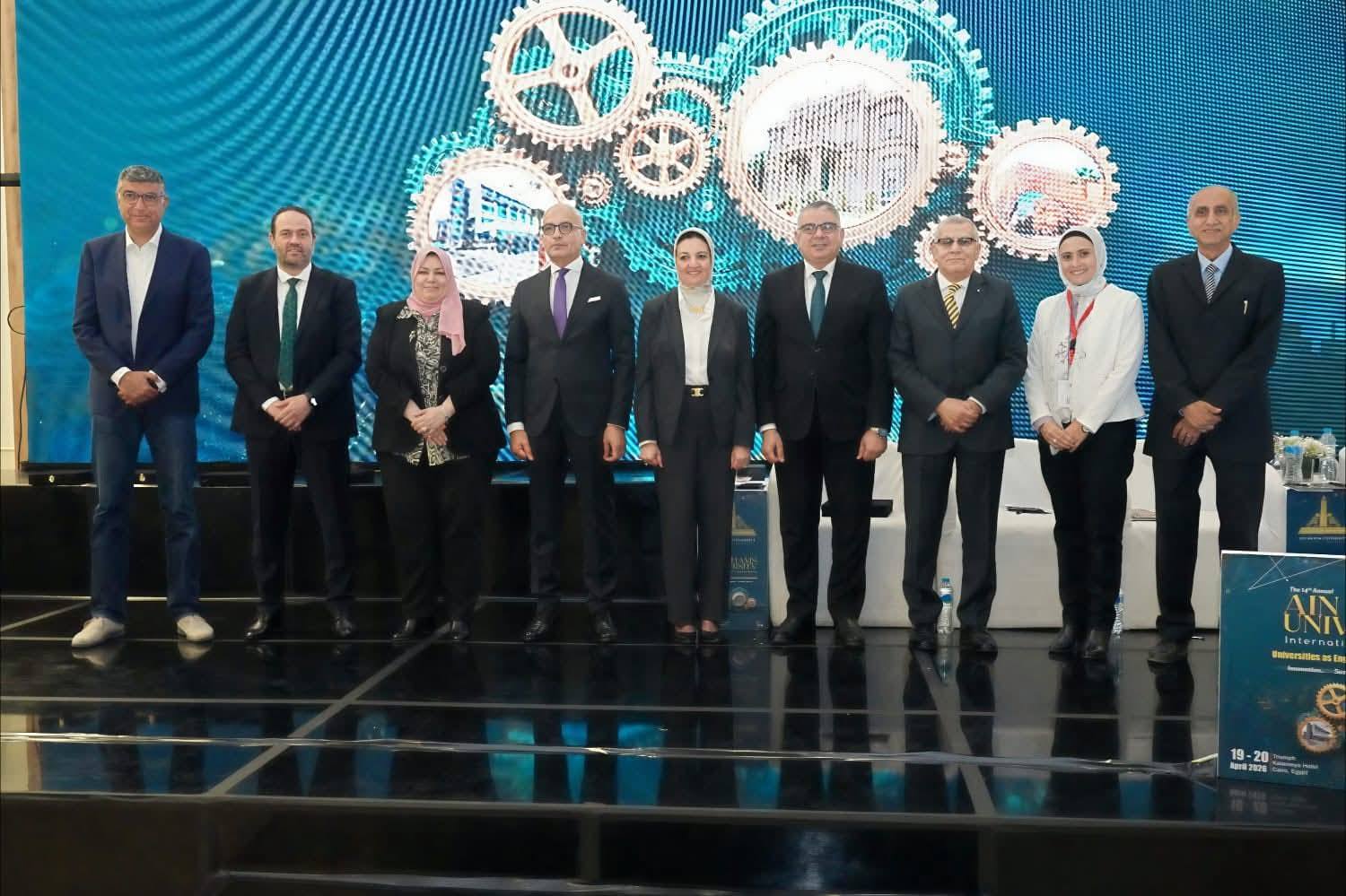
The session was chaired by Prof. Amani Osama Kamel, Vice President for Graduate Studies and Research and Executive President of the Conference, and featured the participation of a distinguished group of experts.
Prof. Amani Osama Kamel inaugurated a series of sessions with the participation of leading academics, technology experts, industry representatives, and entrepreneurs, including:
-
Prof. Khaled Negm, Advisor to the Minister of Communications and Information Technology for Digital Governance
-
Prof. Rasha Ismail, Dean of the Faculty of Computers and Information, Ain Shams University
-
Prof. Farid Moharam, Dean of the Faculty of Commerce, Ain Shams University
-
Prof. Taimour Nazmy, Professor of Computer Science, Faculty of Computers and Information, Ain Shams University
-
Dr. Amal Khalifa, Assistant Professor of Computer Science, Purdue Fort Wayne, USA
-
Prof. Hatem Salam, Founder and CEO of EduSofx
-
Dr. Ibrahim Mohamed, Regional Director for Emerging Markets at Elsevier
-
Eng. Shaimaa Mohamed Sayed Abu Taleb, Senior Data Center Solutions Manager at Dell Technologies
This comes within the university’s vision to enhance digital transformation and build an integrated educational and research ecosystem that supports innovation.
The session was attended by a distinguished group of faculty members, teaching assistants, and students from the Faculty of Computers and Information, reflecting their awareness of the importance of keeping pace with developments in artificial intelligence and their pivotal role in leading it. The session also witnessed wide participation from conference attendees, along with the presence of several deans and vice deans, highlighting the growing importance of this field at the university level.
The session emphasized that artificial intelligence is no longer a future option but a present reality, playing a crucial role in advancing higher education and scientific research. It highlighted the importance of adopting a responsible strategic approach to ensure the effective use of modern technologies, while addressing challenges related to output quality, bias, and risks of informational “hallucinations.”
During a panel discussion, Prof. Mohamed Diaa Zain El-Abedeen, President of the University, stressed that the success of AI initiatives depends on strong partnerships, robust infrastructure, and effective governance policies. He emphasized the importance of ensuring the quality and reliability of outputs, as well as studying funding and implementation mechanisms for the upcoming phase.
Participants also stressed the importance of:
-
Developing digital infrastructure
-
Strengthening institutional policies
-
Expanding partnerships between universities and industry
These are considered essential pillars for successful digital transformation, alongside building qualified cadres capable of handling advanced technologies and meeting the evolving demands of the labor market.
Prof. Rasha Ismail, Dean of the Faculty of Computers and Information, highlighted that artificial intelligence has evolved from traditional analytical tools into generative models capable of producing content and supporting decision-making. She emphasized the importance of adopting the concept of “Responsible AI” to ensure fairness and transparency.
Prof. Khaled Negm discussed the importance of AI governance and data sovereignty, noting that the world is witnessing significant regulatory efforts in this field. He emphasized the need to strengthen integration between scientific research and industry, and to develop predictive and analytical models that support decision-making.
Dr. Amal Khalifa presented multiple perspectives on enhancing university education through AI, including:
-
Transforming educational content into interactive digital formats
-
Utilizing intelligent agents and generative models to improve learning experiences and assessment systems
Prof. Hatem Salam discussed the stages of digital transformation within universities, from automation to full digital transformation, highlighting modern concepts such as digital twins and prompt engineering, and emphasizing the importance of governance to ensure system reliability.
Prof. Farid Moharam reviewed experiences in integrating AI and financial technology into academic curricula through partnerships with national and international institutions, enhancing graduates’ readiness for the digital job market.
In the field of scientific research, Dr. Ibrahim Mohamed highlighted the role of AI in accelerating academic publishing and automating peer review processes, while warning of risks related to bias and lack of transparency. He advocated adopting the “human-in-the-loop” approach to ensure output quality.
Eng. Shaimaa Mohamed Sayed Abu Taleb presented a comprehensive vision for building AI platforms, emphasizing the importance of:
-
Data
-
Strong infrastructure
-
Information security
She also showcased successful applications in justice, transportation, and government services.
In a specialized lecture on generative AI, Prof. Taimour Mohamed presented a strategy for localizing AI technologies through building an institutional framework that includes governance, training, and research, with a focus on small and multimodal models applicable within the university.
The sessions concluded by emphasizing that the real challenge is no longer adopting AI, but rather how to employ it responsibly and strategically, in a way that maximizes its benefits in supporting education, scientific research, and innovation, and enhances the university’s position as a leading institution in digital transformation and future development.